On this page
Quick Answer: Here’s how to calculate calories in homemade food: add the calories from each ingredient, then weigh the finished batch. For a well-mixed dish, divide the total calories by the batch weight in grams and multiply by the grams you serve. If the components are served separately, calculate each one on its own.
1. Match each ingredient to its label or database entry
Write down how much actually went into the dish, including oil, butter, and sauce. If you peeled or trimmed something first, weigh the part that went in. For packaged foods, the FDA’s Nutrition Facts guide explains where to find the serving size and calories per serving. If a label lists 160 calories for 45 g of dry lentils and you use 180 g, that’s four label servings: 180 ÷ 45 × 160 = 640 calories.
For an ingredient without a label, search USDA FoodData Central. Match the entry to what you weighed: raw onion to raw onion, cooked rice to cooked rice, and drained beans to a drained entry. If the entry gives calories per 100 g, divide your grams by 100 and multiply by that value. The USDA data documentation explains the different types of entries. For a packaged ingredient, use the label on your own package if it differs from the database.
2. Add up the whole recipe
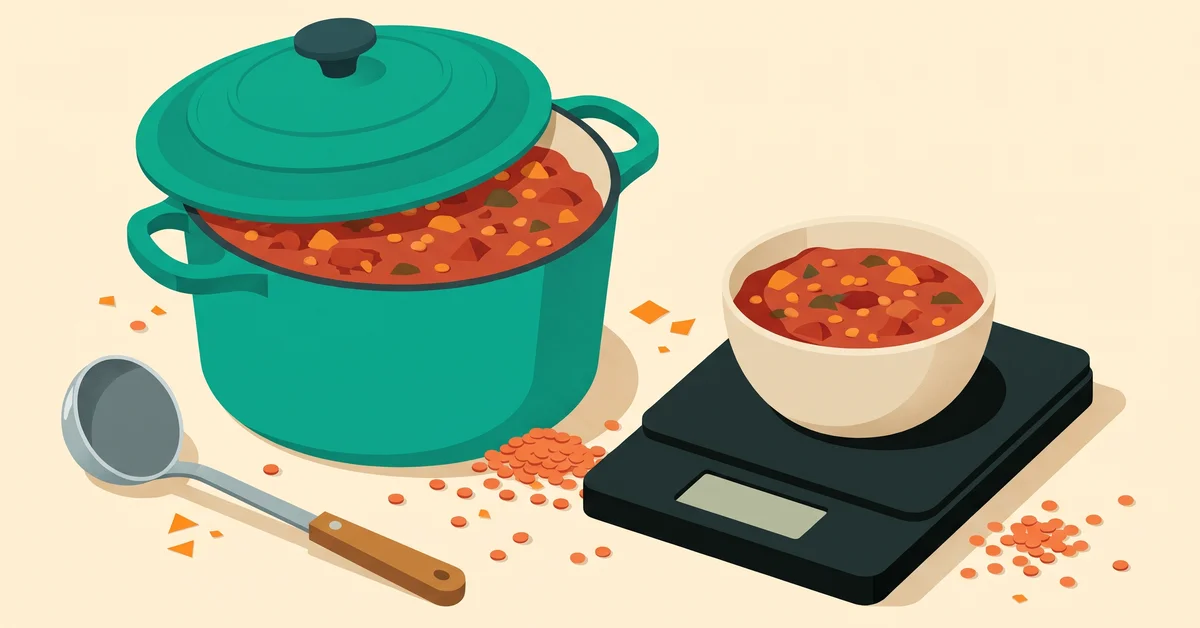
Here’s a lentil stew with example values to make the math easy to follow. Use your own labels and database entries for a real batch. In this example, the oil stays in the stew and there are no toppings yet.
| Ingredient | Amount used | Example calorie value | Calories in the pot |
|---|---|---|---|
| Dry lentils | 180 g | 160 per 45 g | 640 |
| Canned tomatoes, with juice | 400 g | 30 per 125 g | 96 |
| Raw onion | 150 g | 40 per 100 g | 60 |
| Olive oil | 28 g | 120 per 14 g | 240 |
| Total | 1,036 |
Plain water adds weight, not calories. If you use broth instead, include its label value. If you drain fat or discard some of the cooking liquid, the sum of what went in can overstate what remains. Don’t subtract the weight of the drained liquid as though it were all fat. The FAO’s food composition guide covers how changes during cooking affect recipe calculations.
3. Weigh the finished batch, then your portion
Put an empty container on the scale, zero it, and transfer in the stew before serving. Or subtract the empty pot’s weight from the full pot’s weight if your scale can handle it. Stir the stew so the lentils and liquid are distributed before you ladle out a portion. Zero the scale with your empty bowl on it, then add the stew.
Say the cooked batch weighs 1,200 g and you serve 240 g. Your bowl is one fifth of the batch, so it has about 207 calories: 1,036 × 240 ÷ 1,200. Four genuinely equal servings would be 259 calories each. The recipe can say “serves four” without your bowl containing exactly one fourth of the pot. If you pack several lunches at once, the meal-prep guide has ideas for what to cook and pack.
4. Calculate separately when the plate isn’t evenly mixed
For chicken, rice, and sauce, the weight of the plate doesn’t tell you how much of each you served. Weigh each component as you add it, zeroing the scale between additions. Use a matching cooked entry, or apply the batch formula to each component separately if you already calculated its total.
For example, take 90 g from a 300 g cooked chicken batch estimated at 450 calories, and 150 g from a 600 g cooked rice batch estimated at 720 calories. That’s 135 calories of chicken and 180 of rice. Add 15 g of sauce from a bottle that lists 60 calories per 30 g and you get another 30, or 345 calories for the plate. If you put a spoonful of yogurt on the lentil stew, the same principle applies: count the yogurt on top of the bowl, not across the whole pot.
Reuse the math without reusing the wrong batch weight
Write down the batch weight before anyone takes a bowl. If you forget and weigh only the leftovers, don’t divide the entire recipe’s calories by what’s left. If you know the weights of the portions already served, add those back to reconstruct the batch weight. Otherwise, use the original serving count for a rough estimate.
If you cook the same recipe next week with the same amounts, you can reuse the ingredient total. Weigh the finished batch again: a stew that simmers longer can lose more water, so a bowl of the same weight may represent a larger share of the pot. If you change the ingredients, update the total too.
When a calculator saves time
Verywell Fit’s recipe analyzer can do the ingredient arithmetic. Check the matches it picks and the number of servings you enter. The Calorie Control Council calculator is another place to look up individual foods. Neither tells you how big a share of the pot you ladled into your bowl. Keep the batch total and finished weight together so you can work out a different portion tomorrow.
Once you’ve worked out a portion you serve often, you can use a saved meal template to log it again. See the reusable meal template guide or get ProteinLog on the App Store.
FAQ
How do I calculate calories per serving in a homemade recipe?
Divide the recipe’s total calories by the number of servings if they’re equal. For uneven scoops from a well-mixed recipe, multiply the total calories by your portion’s share of the finished batch weight.
Should I weigh ingredients raw or cooked to calculate calories?
Either works if the label or database entry matches how you weighed that ingredient. If you’re calculating a portion of the finished recipe, use the finished weight for both the whole batch and your portion.
Does cooking change the calories per gram?
Yes, if the weight changes. Water absorbed by rice or lost from a stew changes the calories per gram without adding or removing calories by itself. Draining fat or adding oil can change the total calories too.
How do I count oil, sauce, and toppings in homemade food?
Include them in the recipe total if they’re mixed through and stay in the dish. If you add them at the table, count only what goes on your portion. When some oil or sauce is left behind, the result is an estimate.
Can I estimate homemade calories without a kitchen scale?
Yes. Use the measuring units on your labels or database entries and divide the total by the number of roughly equal servings. If the portions vary widely, treat that number as a batch average, not the calories in each plate.
Sources

Ready to Track Smarter, Not Harder?
AI photo logging, verified nutrition data, Apple Watch logging, and our free macro calculator use the same targets as goal setup.
Download on the App StoreiPhone & Apple Watch · No ads · Cancel anytime